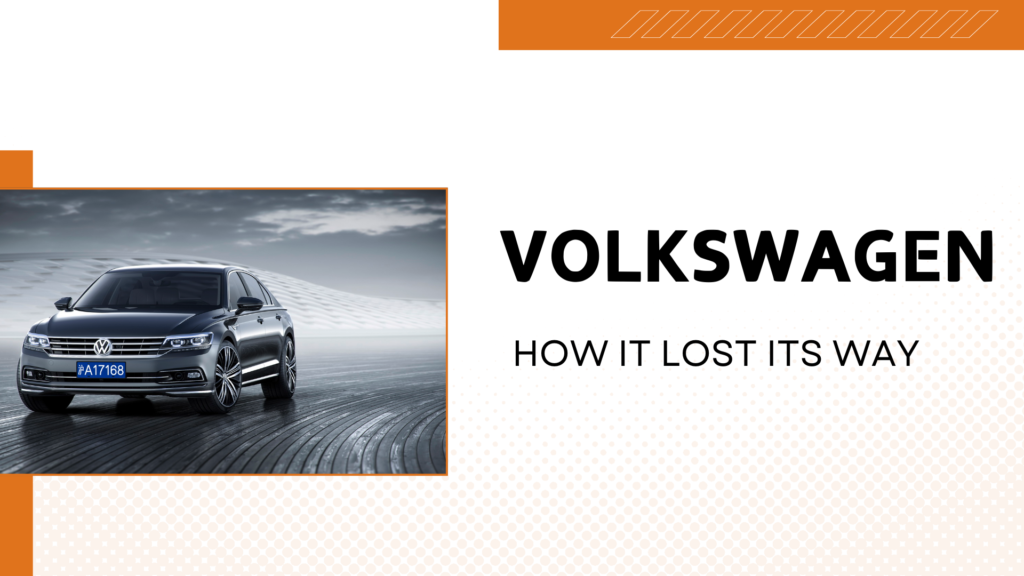


Volkswagen is one of the world’s most famous carmakers. It once stood as a beacon of German engineering and pride. For decades, Volkswagen was known as the maker of the “People’s Car” a car that everyone could afford. But today, Volkswagen is facing a deep crisis. The company that once symbolized German industrial strength is now struggling with many problems. In this article, we will explore how Volkswagen lost its way. We will look at the company’s proud history, its challenges with electrification, fierce competition in China, and the hard choices it must make with its workforce. We will also see how management is trying to save the company by cutting costs and changing its rules. Let’s take a closer look at Volkswagen and understand the many factors that have led to its current struggles.
A Proud History in a Changing World:
Volkswagen has long been an icon of German engineering. For many years, the company was the heart of Germany’s car industry. It was the maker of the “People’s Car,” a vehicle that made car ownership possible for millions. In its prime, Volkswagen was not just a car company; it was a symbol of national pride. Its cars were a pop culture export and a key part of Germany’s modern identity.
At one time, Volkswagen earned billions of euros in sales. In 2023 alone, its portfolio generated around €320 billion in sales. That is a huge amount-it even accounted for about 7.5% of Germany’s GDP that year. For a long time, Volkswagen was considered the pillar of German industry. It employed around 680,000 people around the world and had production sites in many cities. These factories and the jobs they provided were the lifeblood of entire communities.
But the proud story of Volkswagen is now at a major turning point. The very foundations of the company are shaking. Its market value has plummeted by tens of billions of euros, to lows not seen since the financial crisis or the fallout from its infamous emissions scandal. Today, management faces the huge task of saving €17 billion in costs. This is a sign of deep trouble for a company that once had it all.
The Electrification Crisis:
The major challenge facing Volkswagen today is the transition into electric vehicles (EVs). The world is changing fast for the car. Cars are becoming less reliant on diesel and gasoline, instead powered by electricity. This shift will help in bringing down carbon emissions and fighting against climate change. Most nations are aiming to achieve net-zero targets by 2050. The future lies in clean energy and EVs.
However, Volkswagen was severely shaken by the diesel scandal in 2015. It resulted in billions of euros in fines and recall expenses for the firm. It also pushed Volkswagen toward sudden electrification-that was not for which the company was prepared. The company attempted to manufacture its battery factories and begin an in-house unit of its software. Making software and batteries is much different from making cars with a combustion engine.
Tesla now is considered an expert in producing EVs. They are miles ahead in coming up with vehicles that people desire to buy. Volkswagen, meanwhile, is suffering. Its EVs did not take off like what was predicted. In Germany, new-car sales of new EVs dropped. Consumers just do not seem to be as interested in purchasing the cars compared to before. The brand that once saw every German behind its “People’s Car” no longer has an electric version that is affordable or attractive to the public.
The change from combustion engines to electric power is huge. Volkswagen finds that the skills and processes that made it a leader in the past are not as good for this new era. The company has to learn new ways of designing, building, and selling electric cars. But it hasn’t come easily, and the delays are costing Volkswagen dearly.
The Chinese Competition:
Another big challenge Volkswagen faces is the severe competition it faces in China. Volkswagen has been very aggressive in China, the world’s second-largest economy, for several decades. Here it was highly successful and built a strong market position. German cars were considered a symbol of quality and luxury.
However, things are changing. Chinese carmakers have become much better at making electric vehicles. Local brands in China are now churning out competitive EVs that appeal to Chinese buyers. As a result, Volkswagen’s market share in China has steadily declined. Chinese consumers are choosing local brands over Volkswagen because they offer better prices, better technology, or simply more modern designs.
Volkswagen has been taken aback by the emergence of Chinese EV manufacturers. The company may have grown a bit too proud, believing that its long history and reputation would keep customers loyal. This is no longer the case in today’s market. One of the reasons Volkswagen is failing in a global market that is rapidly moving toward electrification is due to the stiff competition from local Chinese companies.
To make things worse, the European Commission has now intervened. Late in 2024, it imposed tariffs on Chinese vehicles to safeguard European carmakers. That is another hurdle Volkswagen needs to cross as it struggles to survive in the stormy waters of international trade and intense global competition.
Workforce Woes and Factory Closures:
The workforce itself has always played a critical role in Volkswagen’s identity. Volkswagen had paid out hundreds of thousands of stable and well-paid jobs to workers over the decades, and these had been the staple of Germany’s middle class. The city of Wolfsburg grew up, in fact around the first Volkswagen factory. Nearly synonymous with Wolfsburg today is Volkswagen itself.
Today, Volkswagen is considering a historic move: the first-ever factory closures in Germany in 87 years. This idea is shocking in a country where cars and their production plants are part of the national soul. The plan to close or restructure up to three factories in Germany is meant to save costs, but it comes with a heavy price. Closing factories means cutting jobs, which could hurt entire communities.
Workers are afraid. Dietmar Tuitje is a veteran, having started at Volkswagen more than three decades ago. This is what it means to feel deep worry among the workers as Tuitje says. Not jobs, but lifelines of families and communities, in these positions. Anxiety about the loss of livelihood and a proud tradition would be how the idea of factory closures has struck places such as Wolfsburg and others with production lines.
The tension between management and the workforce is high. Volkswagen has approximately 140,000 German workers who hold immense political power. The company’s structure is such that regional governments, like the state of Lower Saxony, have a huge say in the decisions of the company. They sit on the supervisory board and work hand in glove with labor unions. This mix of power makes it very hard for Volkswagen to make fast changes. It is like a tug-of-war on saving costs as opposed to safeguarding jobs.
This has given rise to tough negotiations and strikes. Workers claim that the proposed cost-cutting measures will leave many of those high-paying jobs and stable careers behind. The loss is great not only to the workers but to the whole region that has relied on Volkswagen for decades.
Management Struggles and a Cost-Cutting Mission:
A huge cost-cutting need is at the heart of VW’s current crisis, though. Management will need to extract around €17 billion in savings from the firm to stabilize it. CEO Oliver Blume leads this brutal effort. His task is to reshape the future of the company in a very challenging time. To do this, he is ripping up the old rulebook and making difficult decisions.
The pressure is enormous. Volkswagen is at a crossroads where it must change its ways quickly or risk losing its place as a global leader. The company’s market value has fallen drastically, and its brand is under threat. To turn things around, management must make hard choices. These include closing factories, reducing the workforce, and investing in new technology for electric vehicles.
Many investors and market watchers view this as the gravest struggle that Volkswagen has ever faced. For decades, it was a growth story with massive respect. The long-held strengths in traditional car manufacturing are fast fading away. Management is battling uphill to adjust to a dramatically changed world.
The Diesel Scandal: A Watershed:
The moment of critical crisis in Volkswagen’s downfall came in 2015 with the diesel scandal. Volkswagen had been cheating on emissions tests for its diesel engines. The scandal was a huge one; billions of euros in fines, recalls, and a severe hit to the reputation of the company. For many, this was the beginning of Volkswagen’s problems in the modern era.
The scandal left Volkswagen scrambling quickly to make electric vehicles its core business. It was far from smooth sailing. The shift from combustion to electricity was more technological and changed consumer behavior much faster than it had initially expected. As it turns out, building vertically integrated supply chains for batteries and software is an extremely different endeavor than making combustion engine cars. This new world was dominated by players like Tesla and lagging Volkswagen.
The diesel scandal not only hurt Volkswagen financially—it also shattered the trust of many customers and investors. The legacy of this scandal still hangs over the company and continues to affect its performance today.
The Price of Tradition in a Changing Market:
Volkswagen has always been a symbol of German industrial might and tradition. Its success was built on the idea that every person in Germany could own a car. That “People’s Car” became a cultural icon. However, as the market changes, traditions can become a burden. The very factors that once made Volkswagen strong are now part of its weakness.
The company is now caught between two worlds. On the one hand, it must hold on to the traditions and stability that have defined it for decades. On the other, it must transform to meet the challenges of a new era, a time of electrification, global competition, and rapid technological change. This balance is not easy to achieve.
The struggle to modernize while preserving a rich heritage has led to a loss of identity. Volkswagen is caught in a battle between its past glory and the demands of the future. Its long-held principles and methods are no longer enough to compete in today’s fast-changing automotive world.
Global Market Pressures and the Chinese Challenge:
Besides internal conflict, Volkswagen has to contend with intense global competition. Nowhere is this more apparent than in China, the world’s biggest car market. For decades, Volkswagen was China’s undisputed leader. German cars were in high demand and prized for their quality and engineering. However, with the emergence of local Chinese producers, the scenario has changed dramatically.
Chinese companies are now making competitive electric vehicles that attract local buyers. Volkswagen’s market share in China has been slipping as these new brands capture the interest of consumers. This shift is a clear sign that Volkswagen’s old reputation is not enough in the modern market. Local competitors are not only cheaper but are also better tuned to the needs of Chinese customers.
The competition in China is part of a broader trend of global market pressures. The German car industry, once the envy of the world, is now under siege from all sides. The struggle in China is a microcosm of Volkswagen’s larger crisis, a loss of competitive edge in a rapidly evolving market.
The Heavy Burden of the Workforce and Regional Politics:
Another critical challenge for Volkswagen is its enormous workforce and the regional politics attached to it. Volkswagen has deep roots in Germany. It operates ten production locations in the country, many of which are more than just factories, they are the heart of local communities. The idea of closing any of these plants is not taken lightly.
The city of Wolfsburg in Lower Saxony is perhaps the most symbolic. It was erected around Volkswagen’s first factory and closely tied to the identity of the company. The closing of the factory in Wolfsburg would be a severe blow to the city and its people. People would lose their jobs, and their lifestyles would be at risk.
Volkswagen’s management is at the crossroads of cost-cutting, but to protect jobs and maintain the long-standing traditions. In Germany, the unions are extremely powerful. Regional governments and unions have a significant role in the company’s decisions. For instance, the Lower Saxony government has representatives on the supervisory board of Volkswagen. This means that every decision on closing a plant will get many layers of political and social scrutiny.
The conflict between saving money and saving jobs has led to protests and heated negotiations. Workers fear that cost-cutting measures will destroy their livelihoods. Many employees have worked at Volkswagen for decades, and the thought of losing their stable, well-paid jobs is terrifying. This human side of the crisis is as real as the financial numbers on a balance sheet.
Management’s Turnaround Efforts:
Among these, Volkswagen’s management, led by CEO Oliver Blume, is trying to get the company back on the safe side. The management team is working very hard to find €17 billion in cost savings. They are making radical changes to save the company. For example, it considering closing German factories for the first time in 87 years move that is both bold and very controversial.
The electric vehicle products for Volkswagen need improvement. The company is developing new, competitive EV models that will win back customers. The products that are planned, and more so, partnerships with EV companies in China are some of the efforts needed, as these are considered very important to keep the company relevant in the present auto market.
However, these turnaround efforts do not come without many obstacles. A long history of success now sits uncomfortably on the company’s shoulders. Volkswagen needs to break its old habits and adopt a new direction that requires tough decisions and a thorough overhaul of its business model.
The Road Forward: Can Volkswagen Find Its Way Back?
The future of Volkswagen is uncertain. The company stands at a crossroads. On one side lies the familiar path of the past, filled with tradition and stability. On the other, a new path leads toward innovation, electrification, and global competition. To survive and thrive, Volkswagen must choose a new path. But this is not an easy choice.
To many, Volkswagen is more than just a carmaker; it represents Germany’s industrial might and history. Company failures are interpreted as symptoms of more general issues with the economy of Europe. The decline of Volkswagen is seen as a message that even the mightiest of institutions can falter when they are unable to adjust to new times.
Some experts believe that Volkswagen can still find its way back. The company has the resources, talent, and legacy to reinvent itself. However, this will require deep changes in its culture, operations, and strategy. Volkswagen must embrace electrification fully, compete fiercely in global markets like China, and find a way to balance cost-cutting with the needs of its workforce.
The next several years will prove to be crucial. If Volkswagen can bring to the market new, attractive electric vehicles and control its cost escalations, it may regain the lost ground. But that road is long and perilous. The world is changing, and so must Volkswagen.
The Big Picture: Lessons from Volkswagen’s Crisis:
The story of Volkswagen is a lesson for all companies that rest on past glories. Even a company as storied as Volkswagen can lose its way if it does not adapt to new market conditions. The crisis at Volkswagen is not just about cars, it is about the clash between tradition and innovation, between a past of reliable engineering and a future of rapid change.
This crisis also shows how global competition can upend even the largest companies. Volkswagen once ruled the roads with its reputation for quality and engineering. But in today’s world, where new technologies and fast-changing consumer preferences dominate, old assumptions can lead to failure. The diesel scandal, the slow shift to electrification, and the rise of fierce competitors in China are all reminders that no company can rest on its laurels.
Volkswagen’s problems are a wake-up call to the entire auto industry. Companies must be willing to change, invest in new technologies, and meet the challenges of a global market head-on. For Volkswagen, this means a complete rethink of its business model and a willingness to make painful but necessary choices.
Conclusion:
Volkswagen, once a symbol of German engineering and pride, now faces major challenges, from struggling with the shift to electric vehicles and fierce competition in China to deep-rooted workforce issues. Its efforts to cut costs and innovate are critical for survival. Only by embracing change can Volkswagen hope to reclaim its status in the global auto industry.
FAQs:
1. What is Volkswagen known for?
Volkswagen is known as a symbol of German engineering and the maker of the “People’s Car.”
2. Why is Volkswagen struggling today?
The company faces challenges with electrification, fierce competition from China, and tough decisions about factory closures.
3. What was the diesel scandal?
In 2015, Volkswagen was caught cheating on emissions tests, which hurt its reputation and finances.
4. How is electrification affecting Volkswagen?
Volkswagen is slow to adapt to electric vehicles, making it hard to compete with companies like Tesla.
5. Why is the workforce a problem for Volkswagen?
Plans to close factories in Germany threaten jobs and local communities, causing strong opposition from workers.
6. Can Volkswagen recover?
Recovery is possible if Volkswagen adapts to the new market, cuts costs, and builds attractive electric vehicles.




Leave a Reply